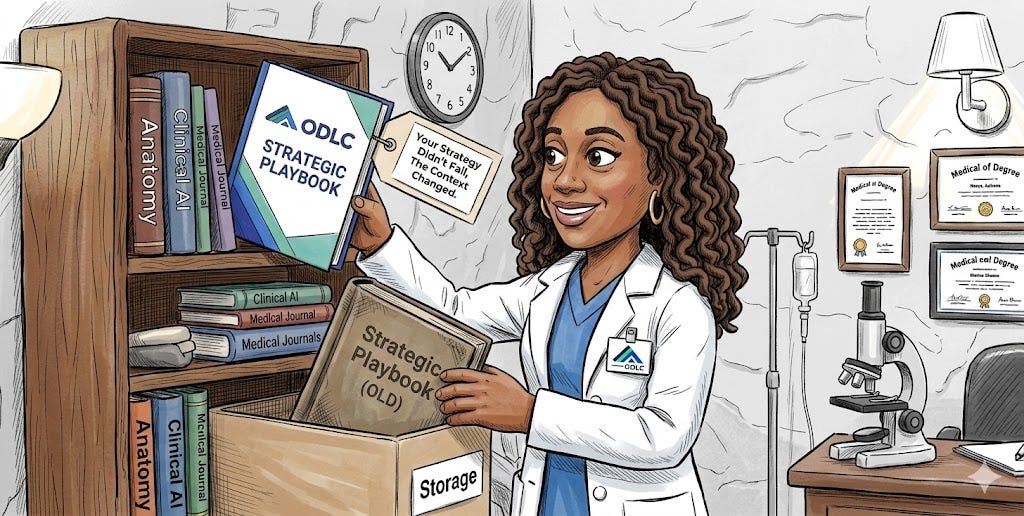
There is a specific kind of doubt that sets in when something you built with care stops producing results.
- A quality improvement initiative that drove real, measurable change for two years suddenly meets resistance at the board level.
- A nationally recognized workforce development program quietly loses its internal funding line.
- A service line strategy built around access and outcomes — one that aligned perfectly with your system’s stated mission — disappears from the strategic plan without a formal decision, without a conversation, almost without a sound.
The instinct for high-performing leaders in those moments is to ask: What did I do wrong? The harder, more important question is: What changed around me?
Right now, health system leaders across the country are sitting with strategies that were well-designed, evidence-grounded, and organizationally championed — and watching them stall. Not because the work was flawed. Not because the outcomes weren’t real. But because the context — political, regulatory, financial, and cultural — has shifted significantly, and faster than most strategic plans anticipated. The old playbook was built for a different operating environment. It no longer fits the one you’re actually in.
SO, WHAT DO YOU DO?
Here is the reframe that changes everything: there is a fundamental difference between updating your strategy and abandoning your purpose. A strategy is a context-specific instrument. The mission — improving outcomes, expanding access, building a workforce that can actually deliver on both — is not. Leaders who hold rigidly to an outdated playbook out of principle aren’t demonstrating integrity. They’re demonstrating an unwillingness to lead in the environment that actually exists. And that rigidity is costly — to their teams, to their patients, and to the systems they are trying to change.
This is exactly the kind of strategic reset that ODLC is designed to support — auditing what’s working, reframing goals in operationally durable language, and rebuilding accountability structures that can carry the mission forward. You don’t have to start over. You don’t have to go it alone. You just have to pick up the playbook that fits the moment you’re actually in.
The old playbook isn’t a failure. It’s a first edition. The question is whether you’re ready to reach for the updated one.
One way to take your strategy to the next level: Read The Leadership Paradox: A Guide to Re-Imagining Equity in a Changing Healthcare Landscape.
If you’re ready to move beyond the old playbook, this is the kind of thinking that opens the door. A practical, inspiring framework for leaders who refuse to let a shifting landscape become an excuse to stand still.
YOUR LEADERSHIP ACTION ITEMS:
- Pull out your current strategic plan and identify one initiative that has stalled. Don’t assume you know why — schedule a 30-minute conversation with the person closest to its execution and ask what they’re running into. The answer may surprise you.
- Run a quick context audit. For your top 3 organizational priorities, ask: Was this designed for the environment we’re operating in today? If the answer is “no” to any of them, flag it for your next leadership team discussion—not to abandon it, but to refresh it.
- Name one goal that needs a new language. Find a commitment in your system that still matters operationally but has become harder to champion publicly. Work with your team this week to reframe it in terms of quality, outcomes, or workforce that are accurate, durable, and harder to dismiss.
- Connect with ODLC. If you’re navigating a strategic reset and want to do it alongside a national network of leaders working through the same moment, reach out. Our consortium exists precisely for this.
Keep Pushing!