Lately, I’ve found myself thinking about this more than ever:
How do we stay motivated when the need feels endless?
In healthcare, and especially in work rooted in improving systems, advancing inclusion, and strengthening communities, there is no shortage of problems to solve.
Access gaps persist.
Teams are stretched.
Expectations continue to rise.
And just when progress is made, there’s always more to do.
But here’s what I’ve come to believe:
Celebrating progress and navigating complexity are not mutually exclusive.
In fact, the leaders who sustain this work over time are the ones who learn how to do both.
There is progress happening—every day, in ways both visible and subtle. But in high-performing environments, we are conditioned to move past it quickly.
We close the loop.We fix the issue. We improve the process. And then we move on.
Over time, something important gets lost:
- The ability to see impact clearly
- The opportunity to reinforce what’s working
- The energy that comes from knowing the work is actually moving forward
Why Recognizing Wins Matters (More Than We Think)
When leaders intentionally recognize wins—both their own and their team’s—it does more than “boost morale.” It sharpens the system.
It tells people:
- This is what success looks like here
- This is what we value
- This is what we should continue doing
And in complex environments, that clarity is everything.
What Happens When We Don’t
When wins go unrecognized:
- Teams feel like they are constantly behind—even when they’re not
- High performers quietly burn out from unacknowledged effort
- Important progress gets normalized and overlooked
- The narrative becomes one of deficit, not advancement
What Happens When We Do
When recognition is consistent and real:
- A clinic team feels ownership after improving follow-up rates for patients with transportation barriers
- A resident feels seen after advocating for a patient whose pain was initially dismissed
- A med tech partner feels aligned when a product or program actually improves workflow—not just adoption metrics
- A leader regains momentum after pausing to acknowledge how much has already been built
ODLC Insight: 5 Wins Leaders Often Miss
If we’re going to do this well, we need to know what to look for. Here are five categories of wins that are often overlooked—but deeply impactful:
1. Progress in the Small Moments
Not every win is a headline metric.
It’s the smoother clinic flow.
The extra five minutes a patient felt heard.
The improved handoff that prevents downstream issues.
👉 These are the signals that systems are improving in real time.
2. Relationships That Strengthen the Work
Trust built across teams.
A new collaboration between clinical and operational leaders.
A moment where someone felt safe enough to speak up.
👉 In health equity and inclusion work, relationships are the infrastructure.
3. Advocacy That Changes a Trajectory
A clinician pushing for the right consult.
A leader elevating a concern that others overlooked.
A team redesigning a workflow to better support a vulnerable population.
👉 These moments often don’t show up in dashboards—but they change outcomes.
4. Course Corrections That Prevent Harm
Catching a gap early.
Adjusting a process before it fails.
Listening to feedback and pivoting.
👉 Prevention is one of the most undervalued forms of success.
5. Team Growth and Ownership
A junior team member stepping into leadership.
A staff member taking initiative on a new idea.
A team that begins to solve problems without waiting for direction.
👉 This is how sustainability is built.
A Simple Practice for This Week
Before moving to the next task, pause and ask:
What just happened that’s worth naming?
Then:
- Say it in a meeting
- Send the message
- Acknowledge it in real time
Not as a performance, but as a reflection of what you actually see.
If you don’t define and recognize the wins, your team won’t know they’re making them. And when people don’t know they’re winning, they disengage—even when they’re doing exceptional work.
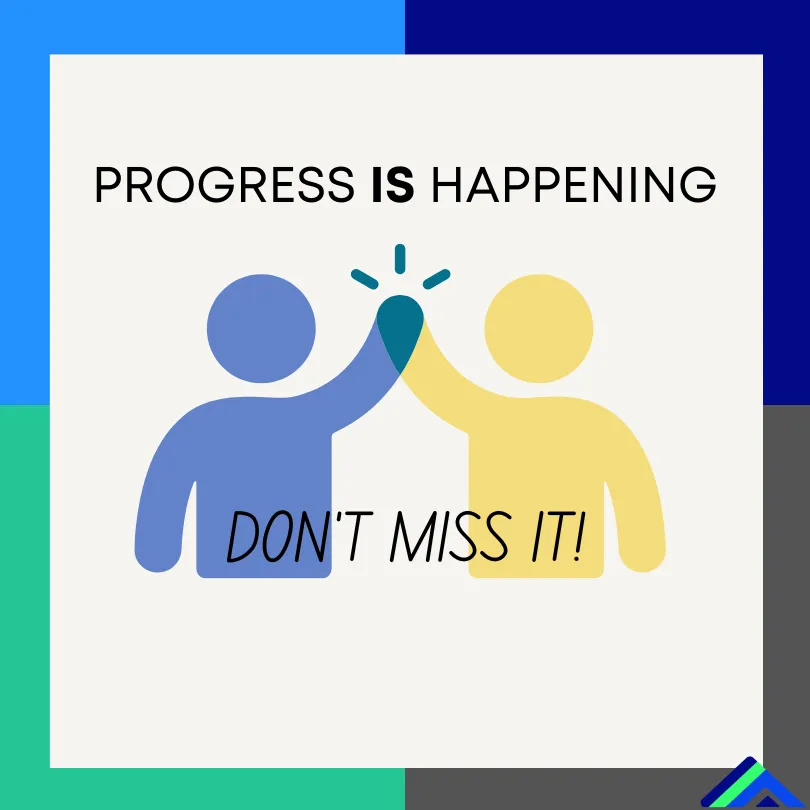
Progress is happening.
Don’t miss it.