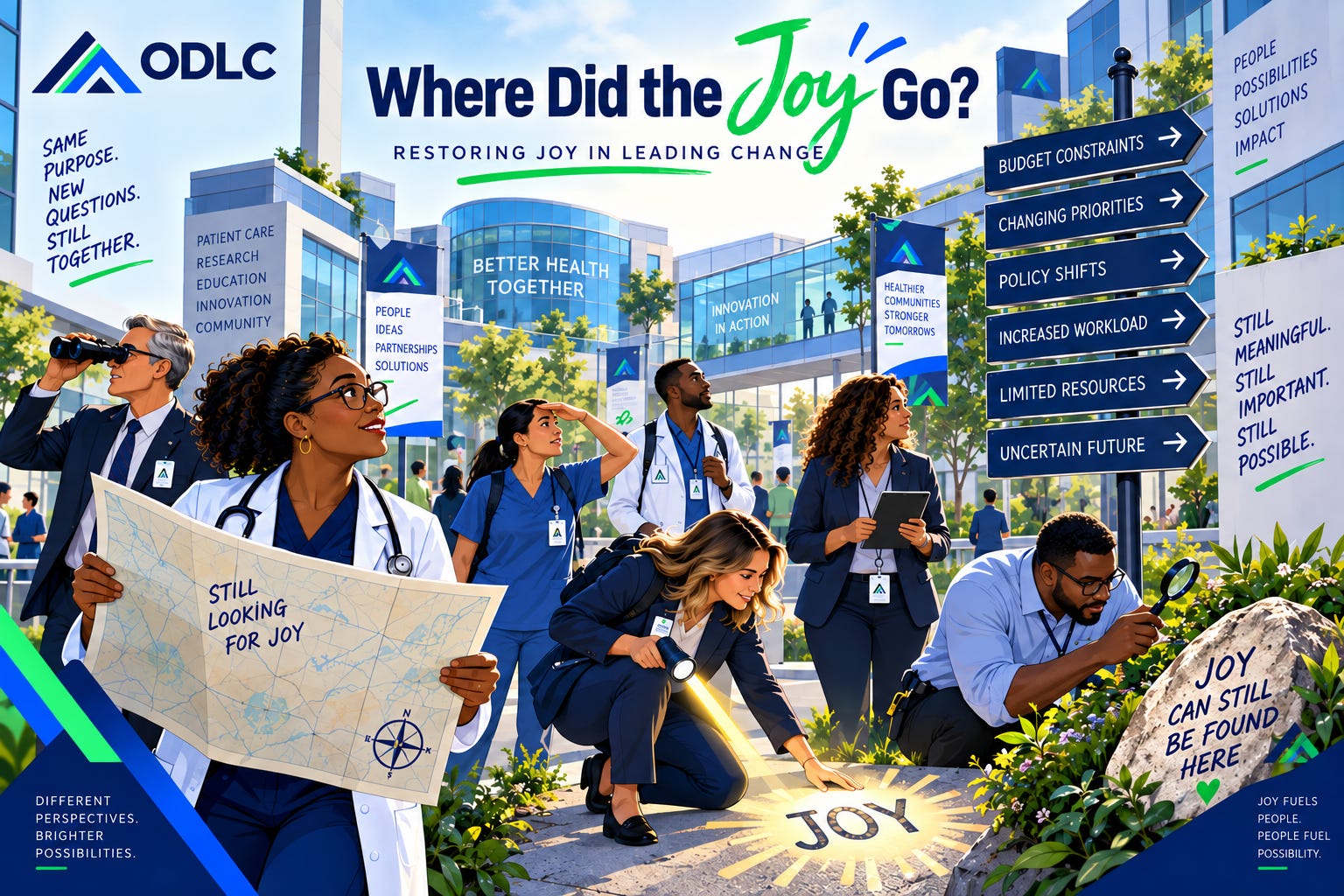
There was a time when leading change felt different.
It was never easy. Most meaningful change isn’t. But there was energy around it.
You had supporters. Colleagues were asking good questions. New partnerships were forming. People from quality, patient experience, workforce, community health, operations, health equity, clinical care, and industry were beginning to realize that we were often looking at different parts of the same problem.
The dots were connecting.
Quality was connected to access. Access was connected to outcomes. Outcomes were connected to trust. Trust was connected to experience. Experience was connected to workforce engagement. Workforce sustainability was connected to whether health systems could reliably care for the communities depending on them.
It was complicated. But it was exciting. And perhaps most importantly, you weren’t doing it alone.
Then something changed. For many leaders, it felt abrupt.
Questions replaced certainty. Some conversations got quieter. Priorities shifted. Budgets tightened. Programs stalled. Funding disappeared or became harder to justify. Teams were asked to absorb more work with fewer resources while simultaneously navigating an already exhausted healthcare environment.
The work didn’t necessarily stop. But it sure became more complicated. And complexity has a cost. Not only in dollars, time, or operational capacity.
It can cost us joy.
So…where did it go?
People ask me fairly often:
“How are you still doing the work?”
I usually chuckle a little to myself. Mostly because I’m not entirely sure what “the work” means.
Is it health equity? Quality improvement? Culture? Leadership? Access? Innovation? Workforce engagement? Community health? System redesign?
Depending on the person asking, I suspect the definition changes.
And maybe that’s the point.
For me, the work has never been defined by a particular program, office, initiative, title, or terminology.
The work is helping healthcare get better.
Better at recognizing what is changing. Better at responding to the needs of patients and communities. Better at designing systems around the people who actually use them. Better at supporting the people responsible for delivering care. Better at translating innovation into something useful. Better at achieving optimal outcomes across the populations we serve.
That work didn’t suddenly become unnecessary because the environment around it changed. If anything, the need became clearer.
As long as quality matters, the work continues. As long as workforce retention matters, the work continues. As long as access, safety, outcomes, experience, affordability, and community health matter, the work continues.
The route may change. The destination hasn’t.
Joy is not fluff. It is infrastructure.
There is actually a substantial evidence base behind this conversation.
The Institute for Healthcare Improvement’s Joy in Work framework describes joy and well-being as more than the absence of burnout. IHI frames joy as a system property, influenced by conditions such as meaning and purpose, choice and autonomy, camaraderie, psychological safety, fairness, and the ability to participate in improving the work itself. (ihi.org)
That matters.
When joy disappears, our instinct is often to look at the individual.
Take some time off. Set better boundaries. Practice resilience. Recharge.
All worthwhile.
But sometimes the question isn’t:
“How do we help people tolerate this better?”
Sometimes the question is:
“What has changed about the conditions surrounding the work?”
Recent evidence on psychological safety reinforces this. A 2025 systematic review found psychological safety intertwined with team learning, speaking up, leadership, engagement, burnout, and the reliable delivery of safe, high-quality care.
Other reviews have similarly connected psychologically safe healthcare teams with learning, innovation, quality improvement, communication, and patient safety.
In other words:
Connection matters. Agency matters. Purpose matters. Voice matters.
Those aren’t accessories to transformation. They are part of how transformation happens. And that may explain why leading change becomes particularly exhausting when those things disappear simultaneously.
The problem isn’t always that people stopped caring. Sometimes they are deeply committed people trying to carry meaningful work through an environment that has become harder to navigate.
Maybe we don’t “find” joy. Maybe we rebuild it.
I don’t think the answer is forced optimism.
There are real constraints facing healthcare organizations right now. There are workforce shortages. There are financial pressures. There are competing priorities. There are political, social, technological, regulatory, and economic forces reshaping the environment around us.
Pretending those things don’t exist isn’t leadership.
But neither is allowing uncertainty to convince us that possibility has disappeared.
Perhaps our job now is to get very good at finding the opportunity hiding inside complexity.
Not alone.
Together.
That is where I think we can SPARK something.
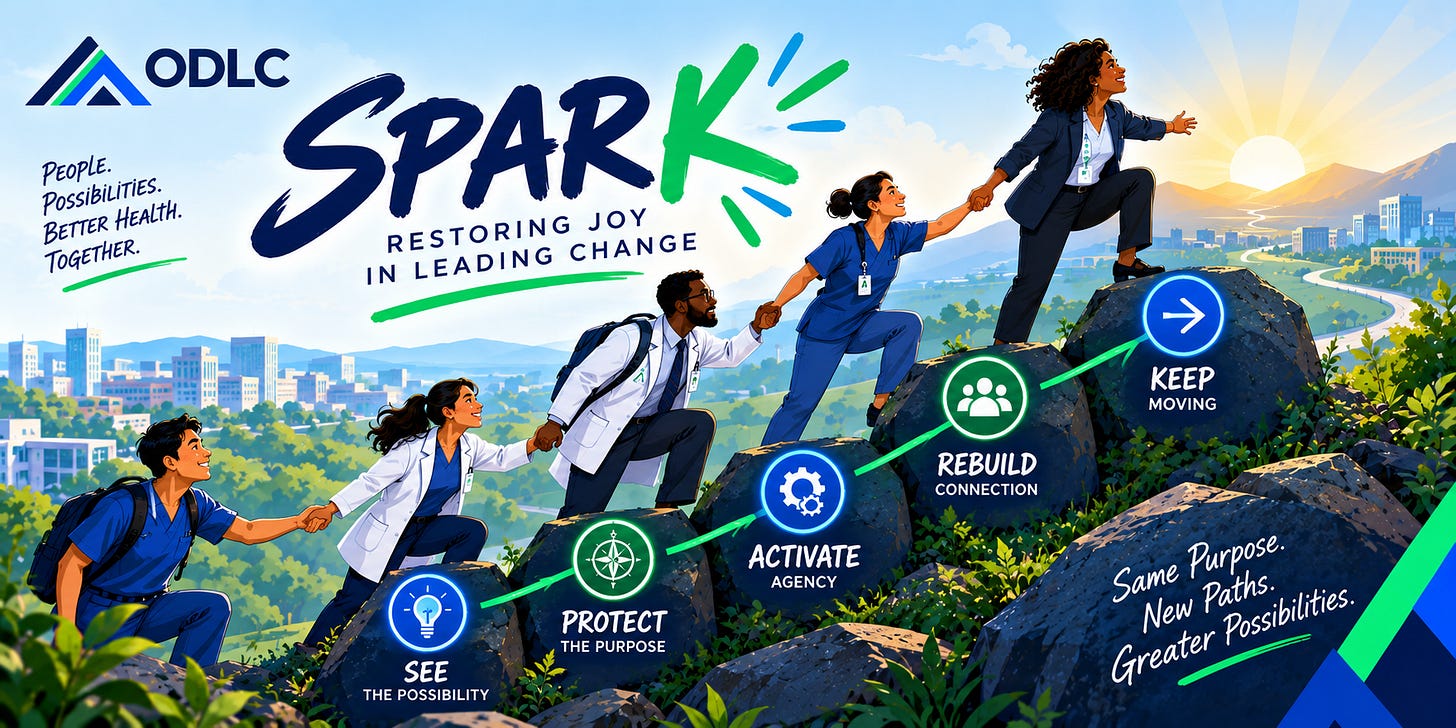
SPARK: Restoring Joy in Leading Change
S — See the possibility.
Change leaders are trained to identify gaps.
What’s broken? Where are the disparities? What isn’t working? What is the failure rate?
Necessary questions. But if we spend too much time focusing exclusively on deficits, leadership itself becomes exhausting.
We also have to ask: What could be true that isn’t true yet?
Possibility gives change somewhere to go.
P — Protect the purpose.
Strategies change. Budgets change. Organizational structures change. Terminology changes. Leadership changes.
The purpose should be more durable. Ask what sits underneath the initiative. If the program disappeared tomorrow, what problem would still need solving?
That is the work worth protecting.
A — Activate agency.
Nothing drains the joy from change faster than feeling powerless. And nothing restores momentum quite like discovering: There is something I can do from where I sit.
Agency doesn’t require complete authority. It requires enough room to influence the next decision, conversation, workflow, partnership, product, patient interaction, or process.
Give people something they can move. Then let them move it.
R — Rebuild connection.
Leading change alone is miserable. Full stop.
That is where ODLC’s mission lives. Leading change alongside people who bring different expertise, networks, lived experiences, disciplines, industries, and perspectives can be exhilarating.
The evidence around psychological safety and team performance tells us something many of us already know intuitively: people do better work when they can speak, question, learn, and contribute together.
So find your people again.
Across departments. Across professions. Across organizations. Across industries.
Sometimes the collaborator you need isn’t sitting in the meeting you’ve been attending for three years.
K — Keep moving.
Not recklessly. Not performatively. Not simply to prove that something is happening.
But move.
Run the pilot. Ask the question. Build the prototype. Make the introduction. Change the workflow. Measure something. Teach someone. Try something small enough to learn from.
Progress creates information, and information creates options.
And options are a powerful antidote to stagnation.
The opportunity in front of us
Healthcare has no shortage of challenges right now. But complexity and possibility can exist at the same time.
There are extraordinary people working across healthcare, life sciences, medtech, business, technology, education, community organizations, and clinical practice who know pieces of the solution.
Our opportunity is to become better at finding one another. Sharing what works. Learning from what doesn’t. Opening our networks. Offering our expertise. Trying something different. And reminding each other why we chose to lead in the first place.
Maybe the joy isn’t hiding.
Maybe we’ve been looking for it in the wrong place.
Joy doesn’t return when uncertainty disappears.
It returns when people can see possibility, reclaim agency, reconnect around purpose, and realize they are not moving alone.
Sometimes, all it takes is a SPARK.
Keep the SPARK Going
Restoring joy in leading change is easier when you are connected to people who are still asking questions, testing ideas, sharing what works, and helping one another move forward.
That is exactly what ODLC was built to do.
See the possibility. Protect the purpose. Activate agency. Rebuild connection. Keep moving.
Then take your next step:
- Go deeper in ODLC Nation to connect with leaders across healthcare, industry, education, and community work who are navigating many of the same challenges.
- Upgrade your ODLC membership for expanded access, leadership resources, priority opportunities, and member benefits designed to help you keep growing.
- Build your leadership toolkit through a Dynamize Health certificate program, with practical frameworks for leading change, improving value, and translating strategy into action.
You do not have to know exactly what the next chapter looks like. You just need enough clarity, connection, and courage to keep moving.
Find your people. Build your tools. Protect your purpose.
Keep the SPARK alive.