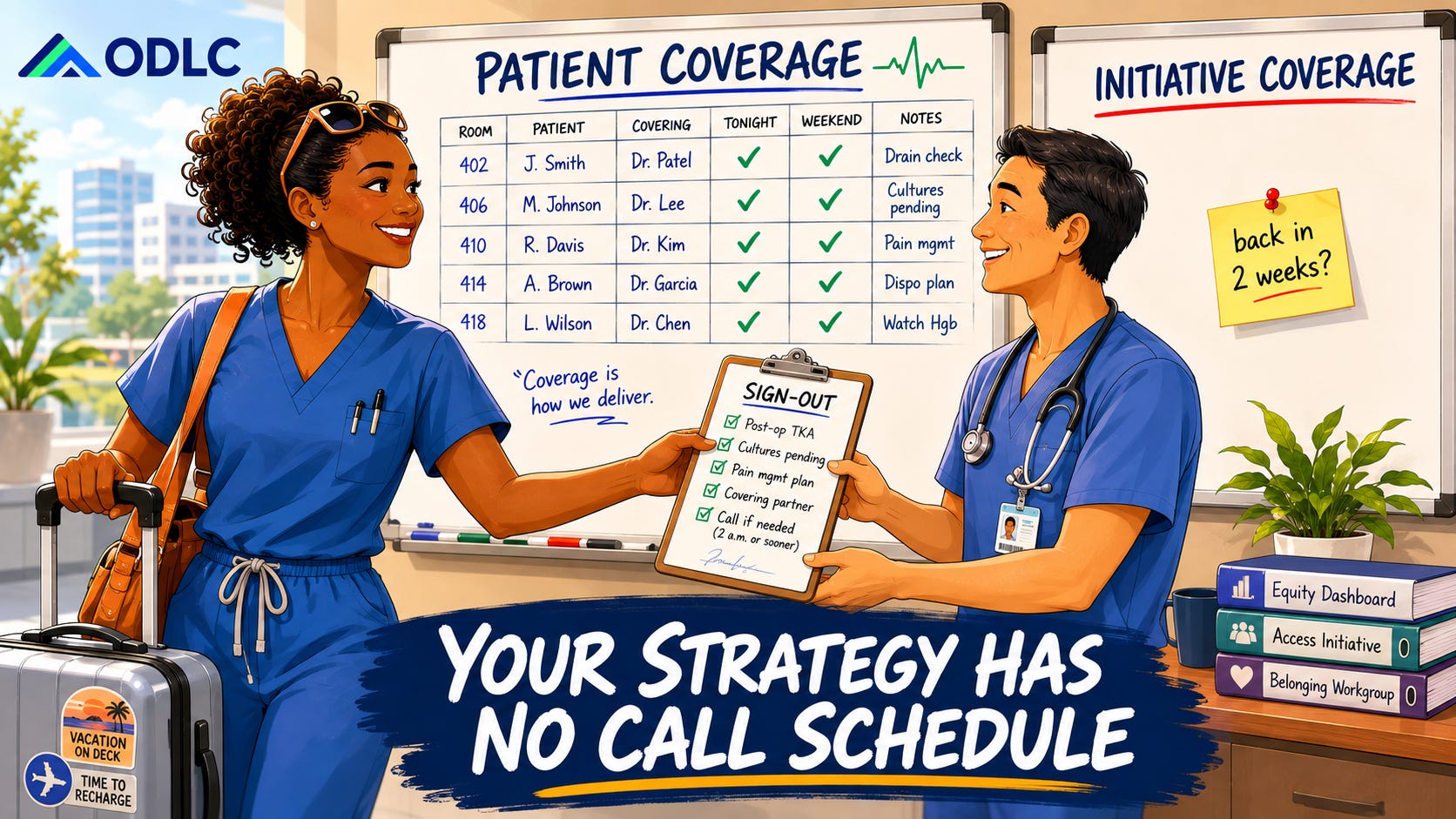
Picture it: early August, and a surgeon is leaving for two weeks. The clinical sign-out takes fifteen minutes and covers everything: the post-op patient with the drainage she’s watching, the pending cultures, which partner is covering, and which number to call at 2 a.m. Fifteen minutes is all it takes because generations of clinical culture built the machinery underneath it: a call schedule, a covering partner, and a sign-out ritual so ingrained that we barely think of it as infrastructure.
Then she closes her laptop on everything else she leads: the equity dashboard rebuild, the service-line access initiative, the workforce belonging committee. No sign-out. No covering owner. No call schedule. That work simply holds its breath until she returns.
We’ve normalized something strange. A leader comes back two weeks later and finds an initiative exactly where she left it, and everyone considers that unremarkable. If a patient sat unattended for two weeks, we would call it a coverage failure. When strategy sits unattended for two weeks, we call it “catching up after vacation.”
JAMA published research involving more than 3,000 U.S. physicians that found that about 70% performed patient-related work while on vacation, while only about half reported full coverage of their EHR inbox. Read that as a systems diagnosis: the physician answering messages from the beach is experiencing a coverage problem one message at a time.
Now consider the strategic work our leaders carry. For much of it, the coverage architecture was never built at all.
THE COVERAGE TEST
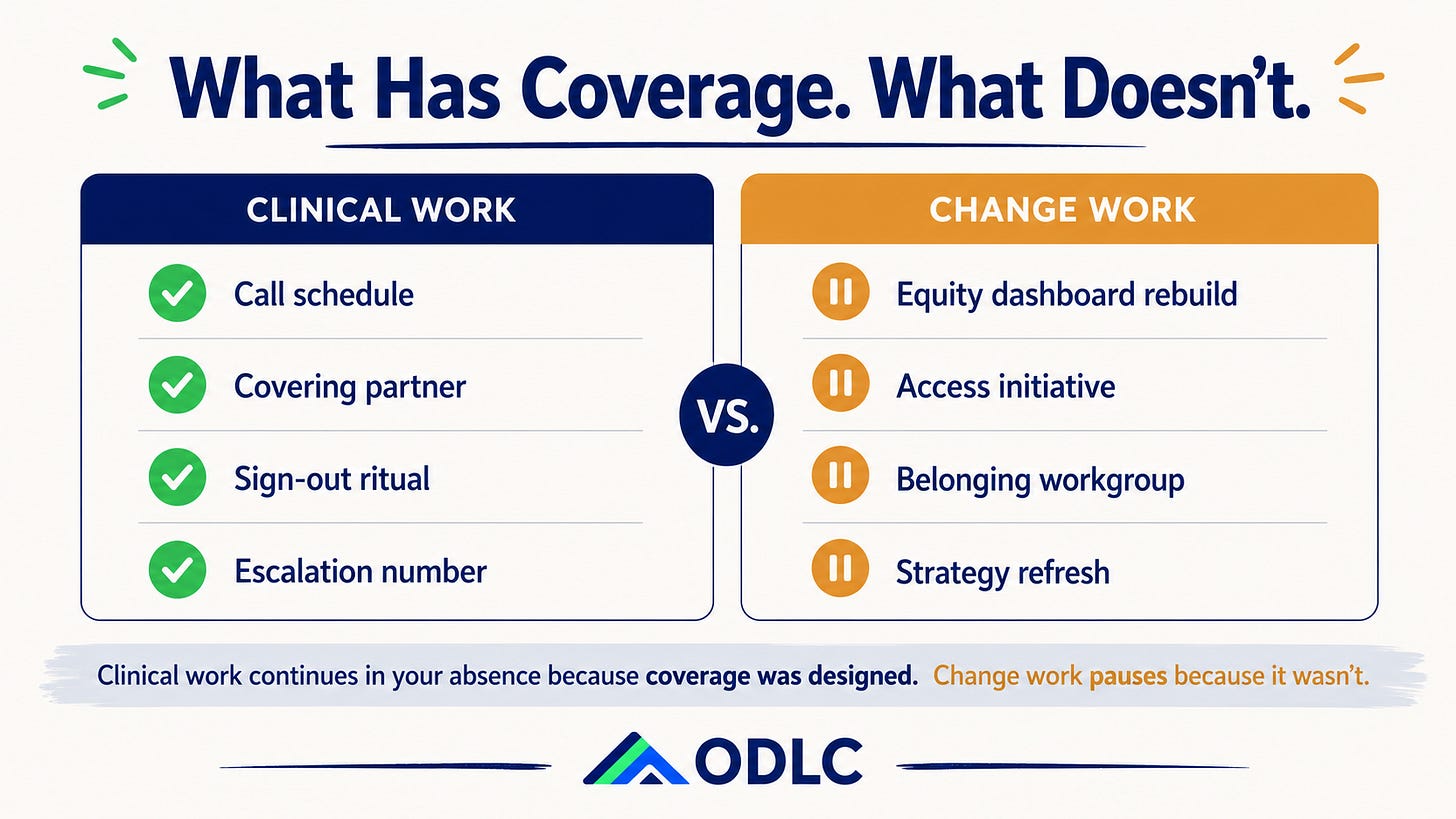
Clinical work continues in your absence because continuity was designed into the system.
What happens to the work you lead when you are not there?
Change the Frame
When leaders return to a stalled initiative, the instinct is personal: I need to catch up. I should have worked further ahead. I’ll stay on top of it next time. But the stall may be telling you something far more useful.
Everything that paused while you were away is a remarkably precise audit of what your organization has not yet institutionalized. The work that continued has begun to belong to the system. The work that froze still belongs to you, and the organization has been borrowing it.
A held initiative can look almost identical to an embedded one for months. Both can have meetings, dashboards, executive sponsorship, and impressive presentations. The difference often becomes visible only when the person holding the work steps away. In that sense, a two-week absence may reveal more about your operating model than a quarterly review.
THE ABSENCE AUDIT
What kept moving? What stalled?
Your stalled list may be the clearest map you have of where leadership effort still needs to become organizational infrastructure.
Translation to Practice
Treat coverage for change work the way we treat coverage for patients: as a design requirement, not a courtesy.
Write the sign-out. Before your next absence, create a one-page summary for each major initiative, including its current status, upcoming decisions, items to watch, and the person empowered to decide. If you cannot name that person, you have found the gap.
Name a covering owner, not simply a point of contact. A contact can answer questions and take messages. A covering owner has defined authority to keep the work moving. That distinction matters, particularly for initiatives that depend heavily on a single leader’s credibility, relationships, or decision-making authority.
Then run the absence audit. Think about your last meaningful time away and ask what continued without you and what stopped. The stalled column is not a reason to cancel your next vacation. It is your institutionalization work plan.
Many leaders in our network have carried important work through reorganizations, leadership transitions, shifting priorities, and seasons when the environment made the work harder to sustain. That persistence matters. But persistence was never supposed to be the operating model.
The next act of leadership is building enough infrastructure around the work that its survival no longer depends on your constant presence.
If it stops when you rest, you’re not leading it. You’re carrying it.
Put It to Work This Week
Choose one initiative you are currently leading and answer four questions:
- Where does it stand?
- Who owns the next decision?
- Who covers when I am unavailable?
- What would stop moving if I disappeared for two weeks?
Whatever you cannot answer clearly is where the work begins.
Where to Go From Here
Explore how strategic work is held by leaders instead of installed in organizations.
Build embedded ownership into your everyday leadership practice.
Compare notes with leaders working through the same challenge.
Leadership is not proven by how much work you can personally carry. It is proven by what continues to move when you are not in the room. Build the coverage. Share the ownership. Protect the rest.