
Picture It. An executive leadership team gathers for its weekly operations meeting.
The agenda is familiar. Staffing shortages. Operating margin. Patient access. Quality metrics. Regulatory updates. Technology implementation.
The dashboards are full. The pressures are real.
Just before the meeting adjourns, someone pauses.
“Before we move on…I want to recognize something.”
A nurse redesigned a discharge workflow that returned fifteen minutes to every bedside team.
A scheduler found a new process that reduced appointment delays.
An industry partner collaborated with frontline clinicians to eliminate a persistent point of friction in the operating room.
A physician noticed the change and simply said, “This made my day easier.”
The room smiles.
Someone claps.
The conversation moves on.
The moment lasts less than two minutes.
Yet those two minutes may have done more for organizational performance than another dashboard slide.
Sound familiar?
Healthcare has become extraordinarily sophisticated at measuring what is broken.
We monitor workforce vacancies, operating margins, safety events, readmissions, patient complaints, clinician productivity, and financial performance with remarkable precision. Executive teams review these measures every week because they matter.
But one of the strongest predictors of long-term organizational performance rarely appears on the dashboard.
Joy at work.
Not happiness.
Not comfort.
Not the absence of difficult work.
Joy.
The feeling that meaningful work is being accomplished, progress is possible, and people are doing it together.
In today’s healthcare environment, that may be one of the greatest strategic advantages an organization can intentionally create.
Change the Frame
The conversation surrounding workforce well-being has become dominated by burnout, resilience, staffing shortages, and retention.
Those conversations are necessary.
But they often share the same underlying assumption: that joy is something organizations experience after they solve their operational challenges.
Fix staffing.
Improve reimbursement.
Reduce administrative burden.
Stabilize the workforce.
Then people will rediscover joy.
The emerging evidence suggests the relationship runs both directions.
Organizations that intentionally design environments where people experience purpose, connection, accomplishment, and progress are often better positioned to solve the very operational challenges they face.
Joy is not simply the product of a healthy organization.
It is one of the characteristics that helps create one.
That distinction fundamentally changes the role of leadership.
Rather than asking how to make people happier, leaders begin asking a different question:
What conditions allow people to experience meaningful work consistently, even during extraordinarily difficult seasons?
That question is becoming increasingly important across healthcare. Whether you lead a health system, a physician practice, a professional society, a medical technology company, or a healthcare innovation organization, sustainable performance depends upon people who remain engaged long after the excitement of a new initiative fades.
The organizations that outperform over time are rarely those with the fewest challenges.
They are the ones that build cultures capable of sustaining people through the challenges.
What the Evidence Tells Us
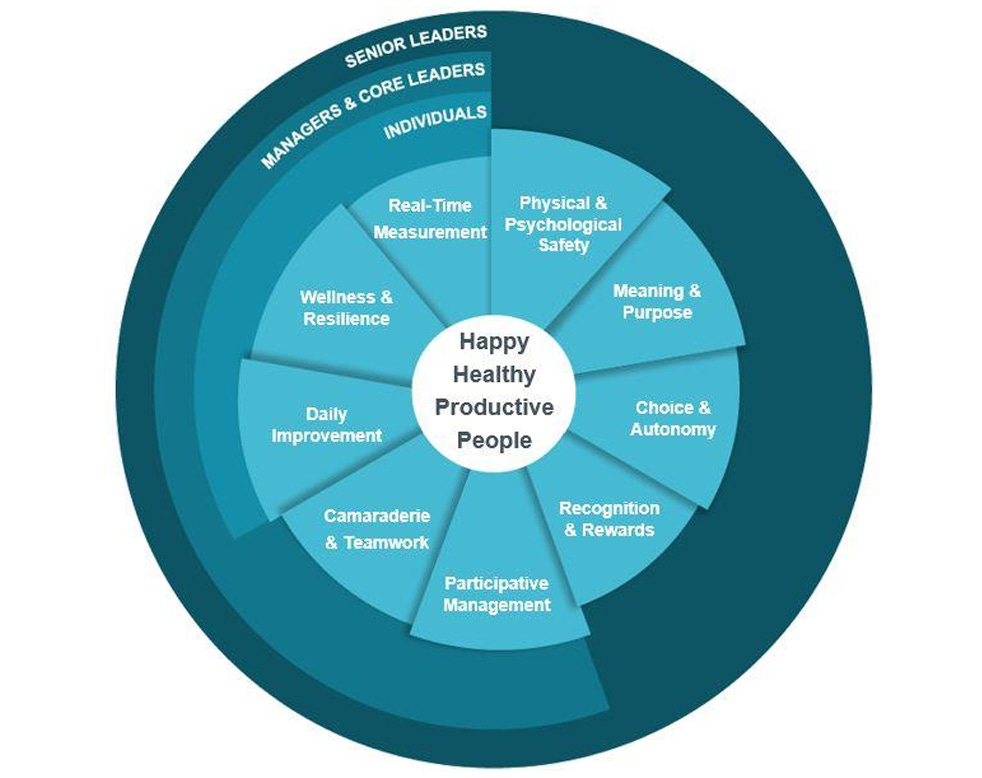
The Institute for Healthcare Improvement (IHI) has helped advance this conversation through its Joy in Work Framework, reframing joy as a characteristic of a well-designed system rather than an individual responsibility or wellness initiative.
The framework encourages organizations to understand what matters most to the workforce, identify and remove barriers to meaningful work, make an explicit organizational commitment to improving the work environment, and apply improvement science to sustain those efforts.
That shift has important implications for healthcare leaders.
If joy is a property of systems rather than personalities, then leadership extends well beyond recognition programs and resilience training.
It includes designing environments where meaningful work can consistently occur.
This perspective aligns with a growing body of evidence linking employee engagement, psychological safety, continuous improvement, and organizational performance. High-performing organizations do not simply ask more of their people.
They remove unnecessary friction, strengthen connections, and intentionally create conditions where people can succeed together.
The question, then, is not whether joy matters.
The question is what leaders should do differently on Monday morning.
Translation to Practice: LIFT
Building upon the principles advanced by IHI, I’ve found that healthcare leaders can intentionally create these conditions through four practical leadership behaviors.
L — Locate Meaning
Healthcare professionals rarely lose sight of what they are doing.
During sustained operational pressure, they often lose sight of why it mattered today.
Leadership requires making that impact visible.
Behind every reduced wait time is a patient who received care sooner.
Behind every workflow improvement is time returned to a nurse.
Behind every successful implementation is a clinician whose day became just a little easier.
Behind every quality metric is a family whose experience improved because the system functioned as intended.
Purpose does not disappear during difficult seasons.
It simply becomes harder to see.
Great leaders help people see it again.
I — Interrupt Friction
One of the most overlooked leadership responsibilities is removing unnecessary complexity.
Every organization accumulates operational friction.
Duplicate documentation.
Confusing approval pathways.
Meetings that no longer serve their purpose.
Technology that creates work rather than reducing it.
Policies that outlive the problems they were designed to solve.
These may appear to be operational inconveniences.
In reality, they communicate something much deeper.
They tell people their time is expendable.
The leaders who consistently improve organizational culture are often the ones who quietly eliminate the small obstacles everyone else has learned to tolerate.
Operational excellence and workforce experience are not separate priorities.
They are deeply connected.
F — Foster Connection
Healthcare has always been a team sport.
The strongest organizations are not defined solely by clinical excellence or technological sophistication.
They are defined by relationships.
People remain committed to organizations where they feel heard, respected, trusted, and connected to something larger than themselves.
That requires intentional leadership.
Invite frontline voices into redesign efforts.
Recognize collaboration as visibly as productivity.
Build psychological safety into operational conversations.
Celebrate shared problem-solving rather than individual heroics.
Connection is not a cultural luxury.
It is operational infrastructure.
T — Track Small Wins
Healthcare excels at measuring failure.
Safety events.
Readmissions.
Turnover.
Financial variance.
Quality gaps.
These measures are essential.
But they represent only one side of organizational performance.
High-performing leaders also make progress visible.
Celebrate the clinic that reduced appointment delays.
Recognize the cross-functional team that simplified a workflow.
Share the patient story that reminds everyone why the work matters.
Small wins create momentum.
Momentum strengthens culture.
Culture sustains performance when the next challenge inevitably arrives.
Leadership Takeaways
Design for joy, don’t wait for it.
Joy should not be viewed as the reward for organizational success. It is one of the conditions that makes sustainable success possible.
Treat friction as a leadership metric.
Every unnecessary obstacle represents an opportunity to improve both operational performance and workforce engagement.
Measure progress as intentionally as problems.
Organizations become what they consistently recognize. Celebrate improvements with the same discipline used to monitor performance gaps.
Reconnect people to purpose.
Meaning remains one of healthcare’s most renewable resources. Leaders who intentionally make impact visible build teams capable of sustaining extraordinary work through extraordinary change.
This Week
At your next leadership meeting, ask one question that probably isn’t on your dashboard:
“What brought our team joy this week?”
The answers may reveal more about the health of your organization than the next performance report ever will.