
Earlier this month, thousands of brand-new physicians walked into teaching hospitals across the country and began caring for actual patients. Many had never written orders that counted. Some got lost on the way to the unit.
And the system held.
It held because nobody expected it to hold on talent alone.
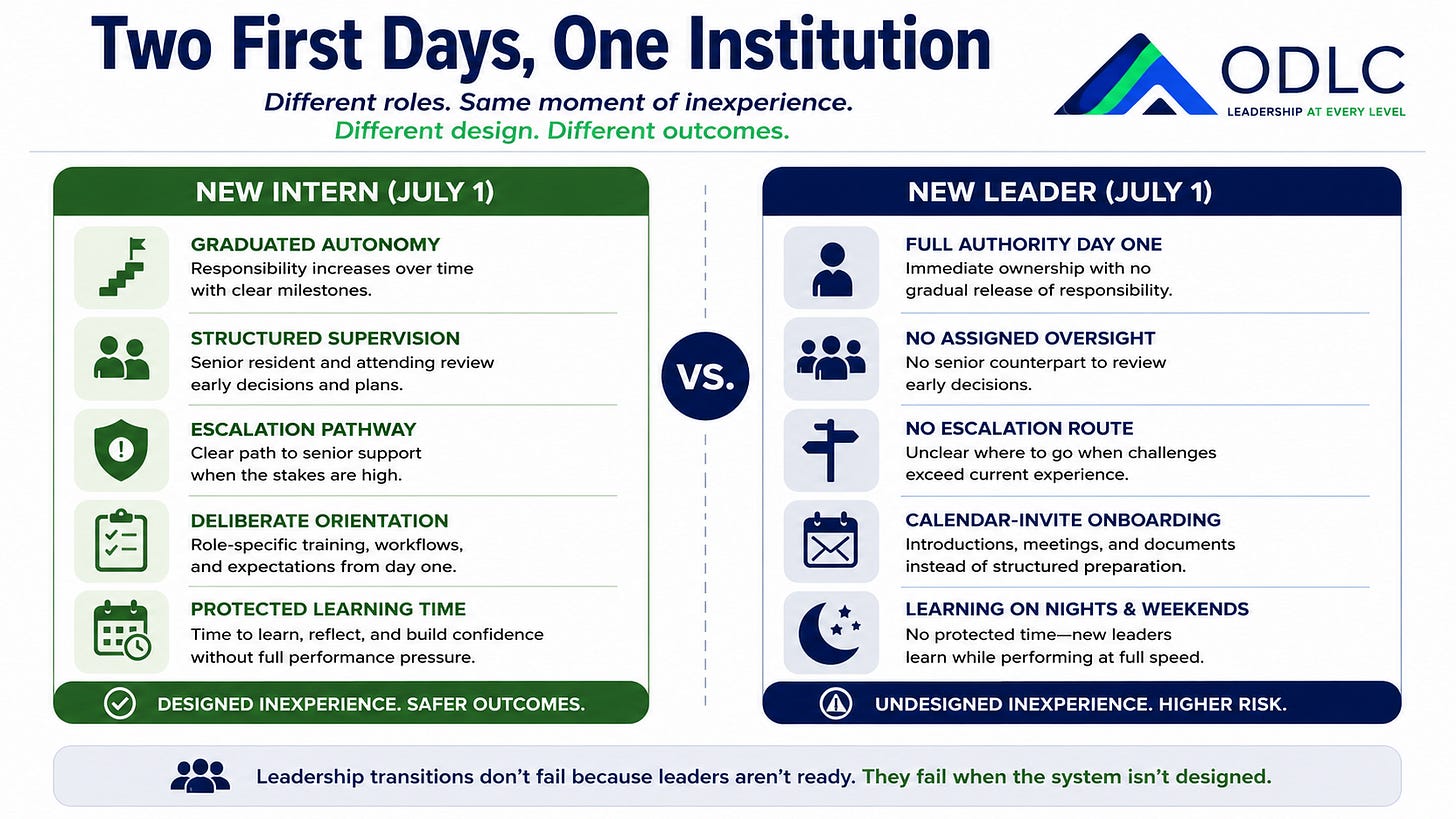
The new intern walked into an architecture built for their inexperience: a senior resident checking their plans, an attending signing their orders, protocols standing guard at high-risk decisions, an escalation pathway taught on day one, and autonomy released in measured doses over months.
Teaching hospitals absorb the least experienced clinical workforce in medicine every July, on schedule, and mostly keep patients safe while doing it.
The “July effect” is real enough to respect. A systematic review in the Annals of Internal Medicine found measurable increases in mortality and decreases in efficiency during the academic changeover. But the more instructive finding lies in the follow-up literature: where supervision is structured, orientation is deliberate, and autonomy is graduated, those effects are blunted considerably. Several studies in surgery and pediatrics found no meaningful rise in errors or adverse events at all.
The risk is predictable, so the system was designed for it.
That design is one of the quiet triumphs of academic medicine.
Now walk one floor up.
Somewhere in that same building, a gifted clinician is beginning a new role as a division chief, medical director, or vice chair.
They receive the title, the inbox, a budget they have never managed, a team with two simmering conflicts, and a performance review scheduled for next spring.
No senior leader is assigned to review their early decisions.
There is no graduated authority.
No explicit escalation pathway.
No protected time to learn.
The institution that engineered every detail of the intern’s first ninety days handed its newest leader a calendar invitation and a login.
Now step outside the hospital.
A high-performing commercial leader has just been promoted to vice president. A clinical expert has moved into medical affairs. A product leader is now responsible for a national portfolio. A regional executive has inherited a new market, a larger team, and a revenue target shaped by decisions they did not make.
They receive the title, the dashboard, the inherited strategy, and the expectation to deliver.
The organization may offer a leadership assessment, a few onboarding meetings, and introductions to key stakeholders. But there is often no structured senior counterpart, no deliberate staging of decision rights, and no protected space to understand the informal architecture that determines how work actually gets done.
Different building.
Same design failure.
Change the Frame
When new leaders struggle, most organizations reach for an individual explanation.
They were not ready.
They lacked executive presence.
They needed more seasoning.
They did not move quickly enough.
The remedy becomes more careful selection, which often means slower promotion and a narrower, more familiar-looking pool. That creates a quiet tax paid disproportionately by leaders who do not already possess inherited access to influential networks, informal sponsors, or unwritten organizational knowledge.
The more useful question is the one academic medicine answered decades ago about interns:
Given that inexperience is guaranteed, what does the system need to look like so that inexperience is safe?
Every healthcare organization already understands some version of this principle.
Hospitals apply it to clinical training.
Life sciences companies apply it to regulated processes.
Medtech organizations apply it to product quality and safety.
Commercial teams use staged market launches, defined approval pathways, and escalating levels of authority.
Yet when people move into leadership, many organizations abandon the very design discipline they apply everywhere else.
Graduated autonomy, structured supervision, explicit escalation, and deliberate orientation are not exotic concepts. What is missing is the decision to treat leadership transitions with the same rigor as clinical training, product development, quality assurance, or market execution.
Leadership development sits in many budgets as a discretionary benefit.
Operational onboarding sits there as infrastructure.
The difference is a choice, and it is costing organizations some of their best people.
Translation to Practice
Monday morning, this translates into four moves.
First, count your “Julys.”
Pull the list of everyone who stepped into a new leadership role during the past twelve months.
That may include medical directors, division chiefs, nurse managers, service line leaders, commercial directors, regional executives, product leaders, medical affairs leaders, operational directors, and newly promoted vice presidents.
For each name, ask what structured support existed during the first ninety days beyond standard HR onboarding, compliance training, introductory meetings, or a handoff from the prior leader.
For many organizations, the honest answer will be a number close to zero.
Seeing that answer in a column changes the conversation.
Second, assign the “senior resident.”
Every new leader needs a named, accountable senior counterpart: an experienced leader, sponsor, mentor, or executive coach with scheduled check-ins during the first ninety days.
That person should help review early high-stakes decisions, stakeholder dynamics, organizational risks, and the informal realities the job description does not reveal.
Informal mentorship does not count.
Informal is exactly what the intern does not get, for good reason.
The new leader should be able to answer, on day one:
Who helps me think through my early high-stakes decisions, and when do we meet?
Third, grade the autonomy.
Decide in advance which decisions the new leader owns outright on day one, which should be made alongside a senior counterpart during the first quarter, and which should remain at a higher level until a defined milestone is reached.
This may include decisions related to staffing, budgets, organizational redesign, market strategy, client commitments, product positioning, clinical partnerships, or reputational risk.
Written down, this may feel bureaucratic.
In practice, it is liberating.
New leaders can take faster, bolder action inside boundaries they understand and trust.
Fourth, budget leadership development as infrastructure.
If leadership development lives in a discretionary line that shrinks every lean cycle, it will never function as a system.
Move it closer to clinical education, quality infrastructure, commercial capability, and operational readiness in how it is funded, structured, measured, and defended.
That means developing leaders before the title arrives, supporting them during the transition, and continuing to build their capabilities once the novelty of the promotion wears off and the real complexity begins.
A leadership title should not be the starting signal for improvised learning.
It should be the next stage in a deliberately designed pathway.
To Our ODLC Community
Many leaders in our network have lived this story. In fact, over 75% of our ODLC members who held leadership roles in equity, inclusion, or diversity were the inaugural leaders in that complex role.
Similarly, you may have been handed a clinical division, an operational team, a product portfolio, a regional market, or a new executive mandate and expected to construct your own scaffolding while performing flawlessly on top of it.
You built it anyway.
That resourcefulness is real, and it should make you proud.
It should not become the permanent operating model.
The clinicians, healthcare executives, industry leaders, and change agents in our community are uniquely positioned to ensure that the people who come behind us inherit a designed system rather than a survival story.
That is the work.
Across the ODLC network, it is already happening.
A new intern inherits a system.
A new leader deserves the same.
Leadership Takeaways
1. Treat leadership inexperience as guaranteed, predictable, and designable.
Selection cannot solve what structure was never built to hold. Design the first ninety days of leadership with the same discipline used for clinical onboarding, product launch readiness, and operational execution.
2. Name the senior partner.
Every new leader should know who will help review early high-stakes decisions, when they will meet, and where to escalate when the stakes exceed their current experience.
3. Graduated autonomy is a gift, not a leash.
Explicitly staged decision rights allow new leaders to move quickly inside trusted boundaries rather than hesitating everywhere at once.
4. Watch who pays for the missing structure.
When onboarding depends on informal networks, the leaders without inherited access to those networks absorb the highest risk. Structure is not only a leadership intervention. It is an equity intervention.
5. This week: audit your leadership transitions.
List everyone promoted into leadership during the past year and document what structured support each person received during the first ninety days. Bring that list to your next executive team or senior leadership meeting.
Where to Go from Here
Find experienced leaders through ODLC Nation.
Leadership becomes more sustainable when leaders can learn from people who have already navigated the terrain.
ODLC Nation connects clinicians, health system executives, medtech and life sciences leaders, entrepreneurs, and emerging change agents who are building stronger teams, redesigning systems, and leading through complexity in real time.
Do not build your leadership scaffolding alone.
Modernize your system design through the Dynamize Health Certificate Programs.
Organizations cannot strengthen leadership pipelines through inspiration alone.
They need leaders who understand how to design change, align stakeholders, improve value, navigate complexity, and translate strategy into execution across clinical, operational, and industry environments.
The Dynamize Health certificate programs provide structured, applied development for clinicians, healthcare executives, and industry leaders who are ready to modernize how their organizations lead and operate.
Get your senior leadership 1:1 mentor through Dynamize Health Coaching.
Sometimes the missing infrastructure is personal.
A new role may bring unfamiliar authority, complex stakeholder dynamics, aggressive performance expectations, competing priorities, and decisions that cannot always be worked through with a direct supervisor.
Dynamize Health Leadership Coaching provides confidential, individualized support for clinicians, healthcare executives, medtech leaders, life sciences professionals, and other industry executives navigating high-stakes transitions, complex decisions, and expanded leadership responsibility.
Think of it as the experienced senior leadership counterpart every new leader should have had from day one.