Picture this.
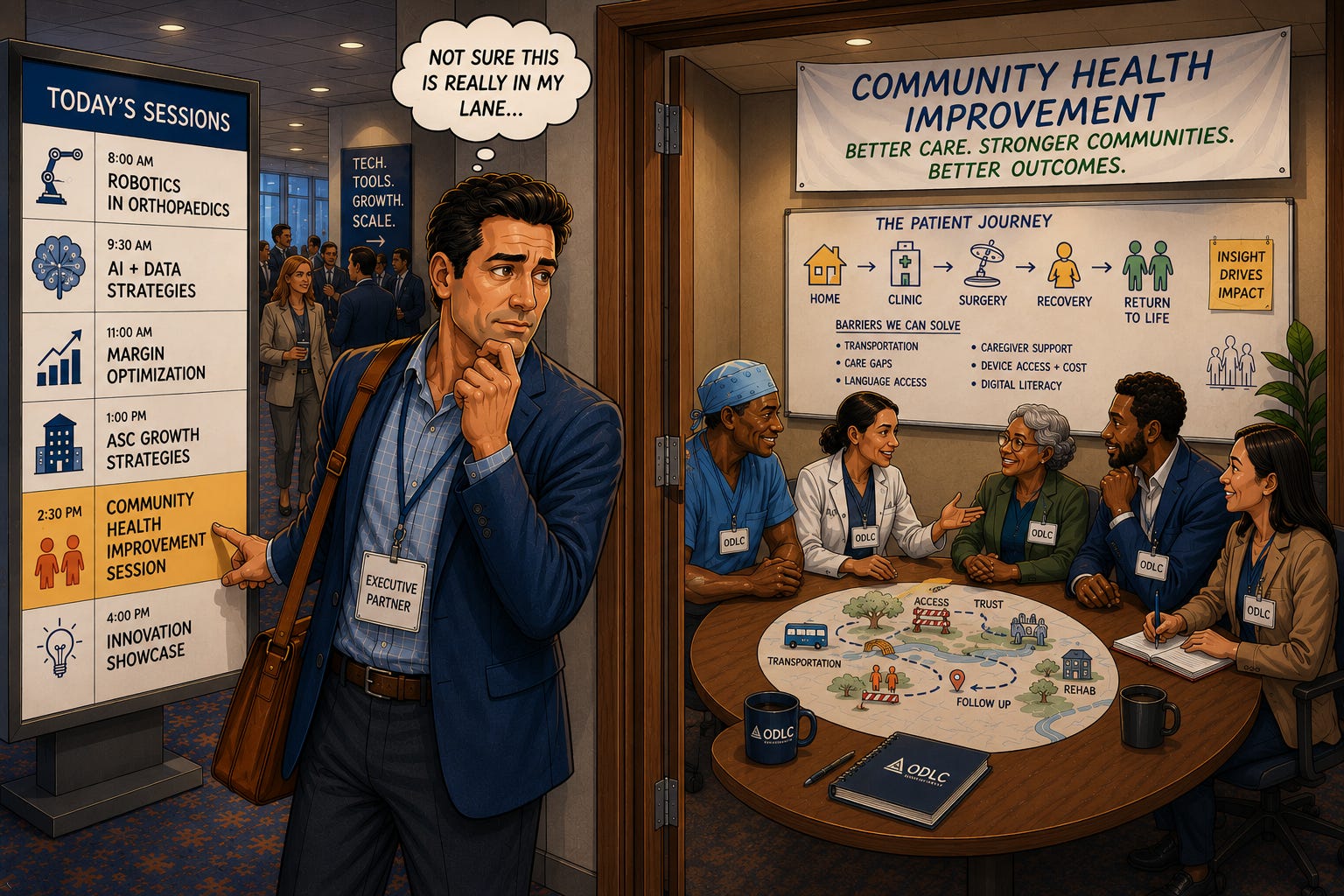
A med tech leader is scanning the agenda at a major healthcare conference. There are sessions on robotics, AI, outpatient migration, reimbursement strategy, surgeon engagement, data platforms, and market growth.
Then, tucked somewhere between the innovation showcase and the executive networking reception, there it is:
Community Health Improvement.
They pause for half a second.
Then they keep scrolling.
Not today.
Their book of business is implants, devices, digital platforms, surgical workflows, value propositions, product adoption, margin, market share, and P&L performance. Community health sounds important, of course. Worthy. Mission-aligned. Maybe even inspiring.
But operationally relevant?
Probably not.
Or imagine a clinician doing the same thing. They are at a packed national meeting, choosing between a session on complex cases and one on community health. The decision feels easy. One seems directly tied to the work. The other feels a little softer, a little broader, a little less connected to tomorrow’s clinic template or Friday’s block time.
So they skip it.
And that may be the leadership blind spot.
Community health is not a “nice to have” session. It is not the charity lane. It is not the soft-focus montage at the end of the strategy deck.
Community health is where the market, the mission, the operating model, and the patient experience all collide.
Community Health Is Not Adjacent to the Business. It Is Embedded in the Business.
For health system leaders, community health shows up as missed appointments, delayed diagnoses, avoidable ED utilization, readmissions, lower patient experience scores, surgical cancellations, inequitable outcomes, and workforce frustration.
For surgeons, it shows up when patients cannot complete pre-op optimization, obtain medications, access therapy, arrange transportation, understand discharge instructions, or recover safely at home.
For med tech leaders, it shows up when a product works beautifully in a controlled environment but meets friction in the real world. Maybe the workflow is too complicated. Maybe the patient-facing instructions assume too much digital access. Maybe the post-acute pathway is weak. Maybe the product solves a technical problem, but not the operational one that determines adoption.
For value-based care leaders, community health shows up in the gap between what the contract rewards and what the system has actually built the capacity to deliver.
That is the point.
Community health is not just about “being good.” It is about being effective.
The Surgical Outcomes Story Hidden in Plain Sight
Consider the surgeon who is frustrated by inconsistent outcomes after a high-volume procedure.
The technique is solid. The implants are reliable. The care pathway looks polished. The team has standardized the pre-op checklist, tightened perioperative protocols, and reviewed complication data.
On paper, everything should be working.
But when the surgeon and care team look closer, they notice something important. The patients with the hardest recoveries are not failing because of the operation itself. They are struggling because of what happens before and after the case.
Some patients cannot take time off work for therapy visits. Some do not have reliable transportation. Some live alone and cannot safely manage early recovery. Some do not understand which symptoms require escalation. Some are afraid to ask questions because every interaction feels rushed. Some cannot afford equipment, medications, or the “small” extras that are only small if you have the resources to absorb them.
So the surgeon stops treating these issues as background noise and starts treating them as clinical intelligence.
The team changes pre-op education to make it more practical and accessible. They identify transportation barriers earlier. They coordinate therapy options with more flexibility. They build clearer post-op escalation pathways. They ask patients what recovery will actually look like at home before the day of surgery. They partner with care coordinators, clinic staff, and community resources instead of assuming the patient can simply “follow the plan.”
The operation did not change.
The ecosystem around the operation did.
And the outcomes improved.
That is community health in action. Not as a slogan. Not as a side project. As a clinical quality strategy.
Three Ways Community Health Matters to You
1. It determines whether access is real or theoretical.
A referral is not access. An available appointment is not access. A surgical slot is not access. A device approval is not access.
Access becomes real only when patients can move through the full care pathway: referral, scheduling, transportation, insurance navigation, language access, pre-op preparation, surgery, recovery, rehabilitation, and follow-up.
If any step breaks, the system may still look functional from the inside while patients experience it as fragmented, confusing, or unreachable.
Leaders who understand community health know how to examine the whole access chain, not just the front door.
2. It shapes outcomes, cost, and value.
In a value-driven environment, we cannot afford to pretend that clinical outcomes are produced only by clinical encounters.
Recovery is shaped by housing stability, food access, caregiver support, transportation, health literacy, employment constraints, insurance design, community trust, digital access, and the ability to navigate complex systems.
Those factors influence complications, readmissions, avoidable utilization, adherence, patient-reported outcomes, and total cost of care.
Community health is not separate from value-based care. It is one of the engines that determines whether value-based care succeeds.
3. It should change how we design products, programs, and care models.
The next generation of healthcare innovation cannot be designed only for the conference stage, the boardroom, the surgical lab, or the idealized workflow diagram.
It has to work in real clinics, real homes, real communities, real operating rooms, real ASCs, and real recovery environments.
For med tech and digital health leaders, community health insight can sharpen product strategy. It can reveal adoption barriers, usability gaps, training needs, patient engagement challenges, and opportunities for differentiation.
The strongest products are not just technically impressive. They are usable, trusted, scalable, and built for the conditions in which care actually happens.
Three Ways to Make Community Health Part of Your Leadership Sustainability Strategy
1. Bring community insight into operating reviews.
Community health should not live only in community benefit reports or annual celebrations. It belongs in the same conversations as access metrics, surgical growth, quality performance, patient experience, readmissions, service line strategy, and innovation planning.
Ask better questions:
Where are patients falling out of the pathway?
Which barriers are driving delays, cancellations, complications, or dissatisfaction?
What do our frontline teams already know that our dashboards are not yet showing us?
What would we redesign if we treated community context as operational intelligence?
2. Build feedback loops with the people closest to the work.
The people closest to the patient often understand the system’s friction points long before they show up in formal reports.
Front desk teams know when patients are confused. Medical assistants know which instructions are not landing. Nurses know which discharge plans are unrealistic. APPs and surgeons know which barriers derail recovery. Patients and families know which parts of the system feel impossible to navigate.
Sustainable leaders create ways for those insights to move upward, outward, and into action.
That is not extra work. That is how strategy becomes honest.
3. Treat community partnerships as infrastructure.
Community partnerships are often framed as goodwill. They are also operational infrastructure.
Trusted community organizations, public health agencies, schools, employers, faith-based organizations, advocacy groups, and local leaders can help health systems understand needs, build trust, close gaps, and design care models that patients can actually use.
The strongest leaders do not wait until a crisis to build these relationships. They invest in them before the need becomes urgent.
The Leadership Takeaway
The community health session you skipped may have been the one that explained why your access strategy is stalling, why your outcomes are uneven, why your product adoption is slower than expected, why your value-based care model is underperforming, or why your team feels like it is working harder without getting further.
Community health is not a side mission.
It is leadership infrastructure, and we are all connected to it.
It is the operating environment for clinical care. It is the context that shapes surgical outcomes. It is the reality check for innovation. It is the difference between designing for healthcare as we imagine it and leading healthcare as patients actually experience it.